The C&I All-in-one Hybrid ESS: Five Cabinets, One Platform
A C&I All-in-one Hybrid ESS cabinet is a hybrid inverter, an LFP battery, a static transfer switch and a generator interface built into one outdoor enclosure. You pick the rating by the peak you have to shave, the energy you cycle each day and the hours of backup your essential loads need.
The five ratings share one battery architecture, one control layer and one set of certificates. What changes between them is power, usable energy, PV input and weight.
One Cabinet, Four Jobs, and a Line We Draw Clearly
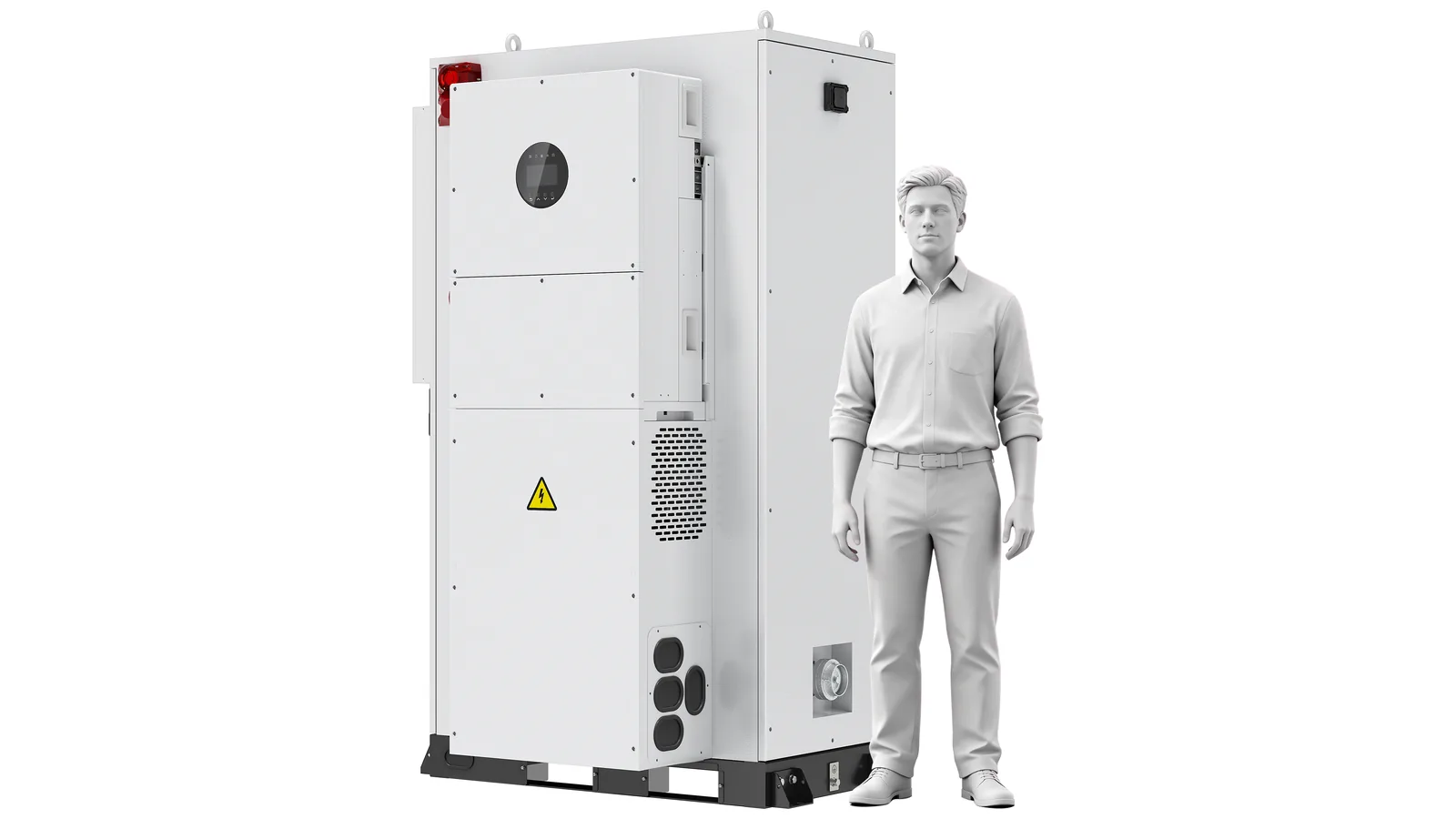
The C&I All-in-one Hybrid ESS puts the PV inverter, the battery, the static transfer switch and the generator interface inside one outdoor cabinet. 37.5 to 60 kW, 80 to 120 kWh, 1349 × 2100 × 990 mm. It stands beside the switchgear; it does not need a plant room, a chiller line or an engine room next to it.
The integration is the product. One cabinet, one commissioning visit, one set of documents, and a site that can take PV, store it, ride through an outage and run in parallel with a diesel generator without a second control panel to learn.
That cabinet is sold to one kind of buyer: commercial and industrial sites behind a 100–400 kVA transformer — factories, warehouses, cold stores and supermarkets, hotels, farms and charging hubs. If that is your site, the five ratings below are the whole decision. Pick by the peak you have to shave and the loads you refuse to lose, not by the biggest number on the datasheet.
What this site does not do: residential-scale projects. A house, a villa or a residential block is outside the scope of this site and outside the way we quote. The series is sold for those applications through other channels, and we say so before the first call rather than after the survey.
If your building has a transformer, a demand charge and an essential board, you are in the right place.
The rest of the page is the specification: the differences between the five models, the parts that are extra, and the sites where this cabinet is the wrong answer.
Five Ratings, Built on One Battery
Every model in the series uses the same 314 Ah LFP cell in a 1P20S pack, the same five-MPPT front end and the same 1349 × 2100 × 990 mm enclosure. The difference is how many packs are fitted and how hard the inverter is allowed to work.
| Model | AC power | Energy | PV input | Weight |
|---|---|---|---|---|
| C&I All-in-one Hybrid ESS BES-H37.5X80 | 37.5 kW / 37.5 kVA | 80 kWh (72 usable) | 75 kWp | 1025 kg |
| C&I All-in-one Hybrid ESS BES-H40X80 | 40 kW / 44 kVA | 80 kWh (72 usable) | 80 kWp | 1025 kg |
| C&I All-in-one Hybrid ESS BES-H49.9X100 | 49.9 kW / 49.9 kVA | 100 kWh (90 usable) | 99.8 kWp | 1165 kg |
| C&I All-in-one Hybrid ESS BES-H50X100 | 50 kW / 55 kVA | 100 kWh (90 usable) | 100 kWp | 1165 kg |
| C&I All-in-one Hybrid ESS BES-H60X120 | 60 kW / 66 kVA | 120 kWh (108 usable) | 120 kWp | 1303 kg |
Dimensions are identical across all five models: 1349 × 2100 × 990 mm. The 15 build combinations offered to projects extend the same platform to other power and energy pairings.
Five Models, One Enclosure: the shell, inverter platform and cooling are shared, and the model code changes the power stage and the number of packs.
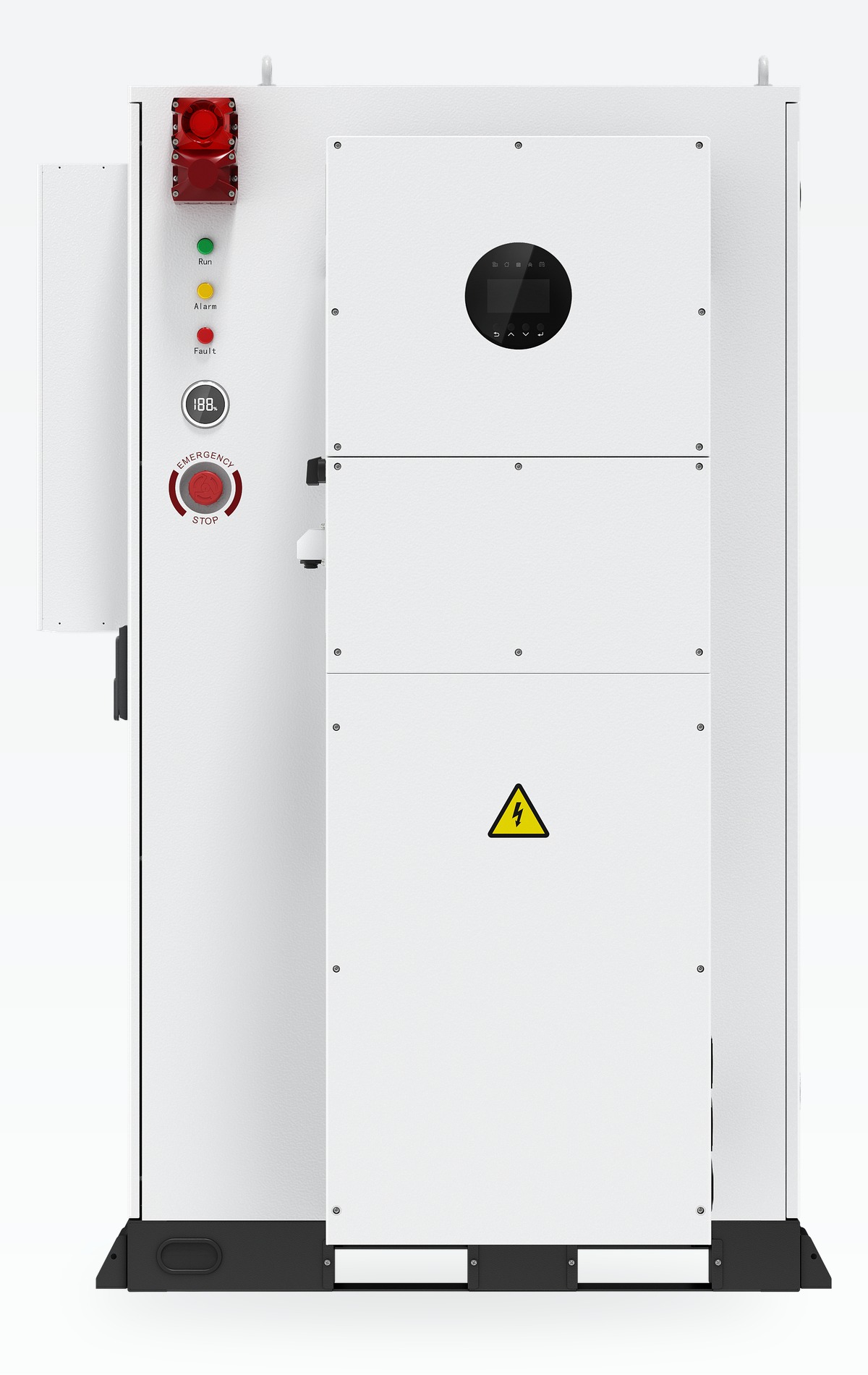
C&I All-in-one Hybrid ESS BES-H37.5X80
37.5 kW / 80 kWh. Same shell, same inverter platform; only the nameplate and the number of packs change.
C&I All-in-one Hybrid ESS BES-H40X80
40 kW / 80 kWh. Same shell, same inverter platform; only the nameplate and the number of packs change.
C&I All-in-one Hybrid ESS BES-H49.9X100
49.9 kW / 100 kWh. Same shell, same inverter platform; only the nameplate and the number of packs change.
C&I All-in-one Hybrid ESS BES-H50X100
50 kW / 100 kWh. Same shell, same inverter platform; only the nameplate and the number of packs change.
C&I All-in-one Hybrid ESS BES-H60X120
60 kW / 120 kWh. Same shell, same inverter platform; only the nameplate and the number of packs change.
Where the Extra Power and Energy Go
Two ratings share a battery, so the choice is not a matter of picking the biggest number. 37.5 kW and 40 kW both carry 80 kWh. 49.9 kW and 50 kW both carry 100 kWh. Only 60 kW comes with 120 kWh.
- Apparent power is what grid codes and transformer sizing look at. The 40 kW build is rated 44 kVA, the 50 kW build 55 kVA, the 60 kW build 66 kVA.
- PV input scales with the battery: 75–80 kWp on the 80 kWh builds, 99.8–100 kWp on the 100 kWh builds, 120 kWp on the 120 kWh build.
- Weight follows the pack count: 1,025 kg with four packs, 1,165 kg with five, 1,303 kg with six. A crane or a forklift moves any of them; two people do not.
If your network operator sizes by apparent power, or your PV array is already fixed, those two numbers decide more than the headline kW figure.
The Parts You Do Not Have to Choose Between
- 90% depth of discharge, so 120 kWh gives 108 kWh of usable energy and 80 kWh gives 72 kWh.
- Transfer to backup in under 10 ms, with 150% overload for 10 s to ride motor starts.
- IP55 cabinet and IP66 inverter, C4 corrosion protection as standard and C5 as an option.
- AFCI, arc-fault detection, string-level shutdown and aerosol fire suppression.
- Five-year warranty on pack, inverter and cooling, extendable to ten.
- Up to ten cabinets in parallel, 600 kW / 4.8 MWh, and four units in parallel on the DC side (the cabinet plus three battery cabinets), 480 kWh in total.
The Inverter Is the Half You Cannot See
Every cabinet carries a three-phase hybrid inverter from the LuminHybrid HP3 platform: one unit, factory-wired to the battery, the transfer switch and the generator port. You do not buy an inverter separately, and the quote should not list one.
| Model | Rated AC power | Max apparent power | Rated / max AC current | Max PV input |
|---|---|---|---|---|
| C&I All-in-one Hybrid ESS BES-H37.5X80 | 37.5 kW | 37.5 kVA | 57 A / 57 A | 75 kWp |
| C&I All-in-one Hybrid ESS BES-H40X80 | 40 kW | 44 kVA | 60.6 A / 66.7 A | 80 kWp |
| C&I All-in-one Hybrid ESS BES-H49.9X100 | 49.9 kW | 49.9 kVA | 75.6 A / 75.6 A | 99.8 kWp |
| C&I All-in-one Hybrid ESS BES-H50X100 | 50 kW | 55 kVA | 75.8 A / 83.4 A | 100 kWp |
| C&I All-in-one Hybrid ESS BES-H60X120 | 60 kW | 66 kVA | 90.9 A / 100 A | 120 kWp |
- Five MPPT inputs, two strings each, 45 A per tracker and 22.5 A per string, so high-current modules do not force a second combiner.
- PV oversizing up to 200% of rated AC, with the surplus charging the battery first.
- Under 10 ms transfer to backup, 100% three-phase unbalanced output, and generator start by dry contact.
- Dual independent battery inputs and AC or DC coupling, which is what makes retrofits to an existing PV plant practical.
- AFCI, Type II surge protection on both DC and AC, and remote firmware updates.
The same platform is sold as a standalone inverter for sites that already own a battery. This site only covers it inside the cabinet, because that is the version with a single warranty and a single commissioning report.
The 30 and 35 kW low-voltage line uses different inverter models (HP3-30KL1 and HP3-35KL1). They are covered on the low-voltage line page.
Match the Cabinet to the Load
Three site patterns cover most of the enquiries we get. The cabinet is chosen by the pattern, then checked against the 15-minute demand profile and the essential-load list.
| Site pattern | Start with | Why |
|---|---|---|
| Peak around 40–60 kW, short backup windows, 100–150 kVA transformer | C&I All-in-one Hybrid ESS BES-H37.5X80 or BES-H40X80 | 72 kWh usable covers a shallow daily cycle without paying for energy you will not move. |
| Peak around 60–90 kW, longer backup, PV already planned | C&I All-in-one Hybrid ESS BES-H49.9X100 or BES-H50X100 | 90 kWh usable and up to 100 kWp of PV input in the same footprint. |
| Peak around 90–120 kW, longer backup, diesel on site | C&I All-in-one Hybrid ESS BES-H60X120 | 108 kWh usable, 120 kWp PV input, 66 kVA apparent power for the generator interface. |
Which model fits my site? Start with the peak you want to shave and the essential loads you want to keep running. If your peak is under 60 kW and the transformer is 100–150 kVA, the 80 or 100 kWh builds cover most cases; above that the 120 kWh build is the one to size. The 15-minute profile and the essential-load list confirm it.
Four More Cabinets for 208/220 V
The global range above is built for 380 to 415 V. Latin American commercial grids often run 208 or 220 V three-phase, and current is higher at the same kilowatts, so the same platform is built as a separate line with its own inverter pairing and its own datasheet.
C&I All-in-one Hybrid ESS (Low Voltage) BES-H30LX80
30 kW and 80 kWh with four packs. The smallest cabinet of the four.
C&I All-in-one Hybrid ESS (Low Voltage) BES-H30LX100
30 kW and 100 kWh with five packs. One more peak in the evening on the same inverter.
C&I All-in-one Hybrid ESS (Low Voltage) BES-H30LX120
30 kW and 120 kWh with six packs. The longest runtime of the 30 kW models.
C&I All-in-one Hybrid ESS (Low Voltage) BES-H35LX120
35 kW and 120 kWh with six packs. The only one of the line on the 35 kW inverter.
Nothing on this page applies to the four low-voltage models: another inverter, another protection setting and another DC window. The wiring differences are on the low-voltage line page.
What the Cabinet Can Start
A cabinet is sized on the current a load pulls in its first second, not on the nameplate. A motor started direct on line draws six to eight times its rated current, and that pulse decides whether the cabinet holds. The ratios below are ceilings measured against the cabinet's rated power, Pn.
| Starting method | Motor rating | What it costs on site |
|---|---|---|
| Direct on line (DOL) | ≤ 1/10 of Pn | Six to eight times rated current for a few tenths of a second. Only with the rest of the site load off at that moment. |
| Star-delta | ≤ 1/5 of Pn | Starts at about a third of the direct-on-line current, in two steps, with a torque dip at the changeover. |
| Soft starter | ≤ 1/5 to 1/3 of Pn | Ramp of 5 to 30 s with current limited to three or four times rated. |
| Variable frequency drive | ≤ 2/3 of Pn | Current stays near rated from zero, so this one starts the largest motor of the five methods. |
| High-impact non-linear load | ≤ 1/20 of Pn | Welders, crushers, compressors: a pulse train rather than one start, sized on the measured profile. |
The ceilings hold for the whole bus and do not add up. A 60 kW cabinet covers a 6 kW motor direct on line, 12 kW on a star-delta, up to 20 kW on a soft starter and 40 kW on a drive, with the rest of the load off at the start.
The cabinet holds 150% of rated power for 10 s. That covers a start, not a motor running off the battery for hours. Above these ratios, ask for the measured load profile rather than a larger cabinet.
Questions about the range
What is the difference between the 49.9 kW and 50 kW models?
They share the same 100 kWh battery and the same footprint. The 50 kW build carries a higher apparent-power rating, 55 kVA against 49.9 kVA, and a slightly higher PV input. Which one applies depends on the grid code your network operator uses and the PV array you plan to connect. We confirm both before quoting.
Can I add capacity after installation?
Yes, the cabinet plus up to three battery cabinets can run as four units in parallel on the DC side, taking a single system from 120 kWh to 480 kWh. Power stays the same; only runtime grows. Up to ten units can be paralleled on the AC side for 600 kW / 4.8 MWh.
Do I need three-phase power?
All five models connect to 3L/N/PE 380, 400 or 415 V at 50 or 60 Hz. Single-phase backup is limited to 22 kW per phase, so a site with large single-phase loads needs those checked against the essential-load list.
How much PV can I connect?
Between 75 and 120 kWp depending on the model, on five MPPT trackers with two strings each and a maximum string current of 22.5 A. The DC input is rated to 1100 V with an MPPT window of 150–1000 V.
What certifications come with the cabinet?
CB IEC 62619:2022 for the battery, CB IEC 63056 for the battery system and CEI 0-21 for the Italian grid connection.
What communication interfaces does the cabinet have?
RS485, CAN, Ethernet and dry contacts (DI/DO) are available on the cabinet. Wi-Fi and 4G come through the iEMS gateway or an optional stick logger. Integration with a site controller or SCADA uses Modbus RTU or Modbus TCP.
How is the cabinet monitored, and what do the indicator lights mean?
Cloud monitoring runs through the iEMS gateway: real-time status, alarm history, remote diagnosis and over-the-air firmware updates. On the cabinet, Run, Alarm and Fault indicators show local status. Most software faults are fixed remotely, before a site visit.
Can I use high-current PV modules?
Yes. Each MPPT channel accepts up to 45 A and each string up to 22.5 A, with five MPPTs and two strings per tracker. Check the module's operating current, short-circuit current (55 A per channel maximum) and string voltage against the 150–1,000 V MPPT window before design.
What fire protection is included?
Each cabinet carries an aerosol suppression canister, smoke and temperature sensors, an explosion relief valve and a sound-and-light alarm. AFCI and string-level shutdown cover the PV side. The suppression canister has a two-year warranty, separate from the five-year cover on the pack, inverter and cooling.
What is inside a battery energy storage system like this one?
Four things in one IP55 enclosure: a hybrid inverter, LFP battery packs (four, five or six depending on the model), a static transfer switch and the generator interface. The EMS and the metering sit around it and are quoted with the scope.
Is a BESS system always a container?
No. A BESS system can be one cabinet on a concrete pad or a row of containers. This range is the cabinet end of that market: 37.5 to 60 kW and 80 to 120 kWh per unit, up to ten in parallel.
What is a BESS system, explained in one paragraph?
A BESS system is one enclosure holding LFP packs, a hybrid inverter, a static transfer switch and the controls, connected behind your meter. It charges when power is cheap or surplus and discharges into the site board when the load peaks or the grid drops.
What does a BESS system cost, and why is there no list price?
Because the scope moves more than the equipment: battery cabinets, metering, site works and grid connection change the number. We quote line by line instead of publishing a figure that would be wrong for most sites.
Request a Quote
No attachments at this stage. We aim to reply within two working days of a complete enquiry, with the scope broken out and every assumption written down. If a cabinet does not make sense for your site, we say so.